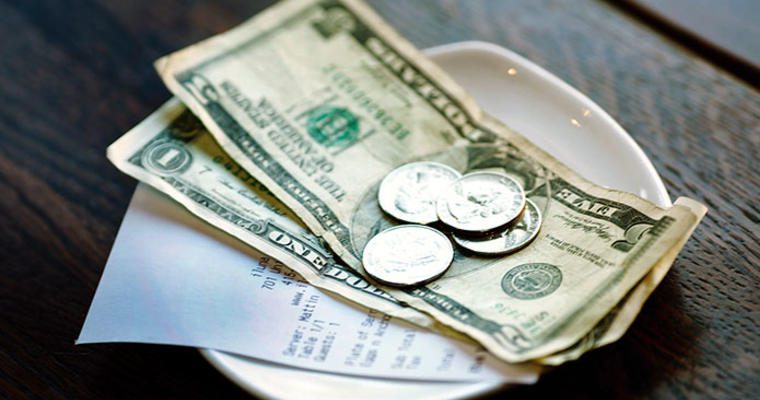
Like Halley’s Comet, every few years or so a trend comes zipping through the hospitality industry. This time it’s abandoning tipping, one of the American restaurant’s defining characteristics.
Late in 2015, Union Square Hospitality Group, a New York-based string of restaurants and creator of Shake Shack, the fast-casual burger chain, announced it would eliminate tipping by the end of 2016 at its 13 full-service restaurants in New York. Union Square CEO Danny Meyer laid out his reasons on the group’s website. To “provide even more meaningful career opportunities and advancement for our 1,800 employees,” Meyer wrote that it became clear that tipping was a “major obstacle” to achieving those goals.
Also citing “countless laws and regulations” that determine which employees can, and cannot, share in gratuities, Meyer said the change wouldn’t cost customers much more.
The move by Meyer—whose operations have won 26 James Beard awards—had an almost immediate ripple effect. The Modern, the first Union Square restaurant to abolish tipping, had an uptick in job applicants, unusual in big markets, where skilled back-of-the-house workers are becoming scarce. In the wake of that news, similar high-end restaurants around the country followed Meyer’s lead and eliminated tipping.
The move begs questions: Is abolishing tipping a smart strategy? How will it work for restaurateurs, employees and customers? Will this trend fade?
No tipping: A brief history
In the 1980s, legislation making operators responsible for paying taxes on tipped income sparked a wave of no-tipping policies. This time, the spark is the specter of a $15 an hour minimum wage, and the elimination of the sub-minimum wage for tipped workers.
Waiters, even those earning a sub-minimum “tip” wage, make considerably more than untipped hourly workers. To raise their base wage and continue tipping policies would make the wage difference between servers and untipped hourly wage workers “untenable,” says Michael Lynn, Professor of Food and Beverage Management at Cornell University. “Cooks need professional training; servers do not.”
Likely winners
No-tipping policies, Lynn says, are “bad for waiters and probably better for everyone else.” Wait staff, he predicts, will earn less. Operators will most likely benefit; charging, say, a 15 percent “administrative” fee would allow them to distribute extra income more evenly around the operation. No-tipping policies can also make bookkeeping easier; in some municipalities tips are subject to federal, state and local tax laws.
Employee-recruitment policies may also benefit from no-tipping policies and be “a way to combat the exodus of employees out of the industry,” says Gordon Food Service Customer Effectiveness Manager Ken Wasco. Workers who flooded the industry during the recession, he notes, are now moving to higher-paying manufacturing jobs. Higher wages could help foodservice compete for high-quality employees.
Likely losers
Diners have become accustomed to tipping. Eight in 10 Americans favor tipping, according to a January 2016 survey by Horizon Media. A late 2015 poll by research firm AlixPartners showed that 65 percent of diners would rather eat in a restaurant where they can control how much they tip.
The other side of that particular coin? To cover higher wages restaurants would have to raise prices, which could cause a dip in sales. “Eating out is pretty price-elastic,” Lynn says. “Price goes up, demand goes down.”
“It’s easier to go from $28 to $30 for an entrée when you’re a high-end restaurant,” says Claire Crowell—Chief Operations Officer of Puckett’s Grocery, and five other restaurants, where all-day per-person checks average $15 to $20—but if you’re serving a $10 entrée, and have to raise it to $16, that’s a huge difference. In the customers’ eyes, you’re no longer value-based.”
Crowell predicts that the no-tipping trend will remain confined to high-end restaurants, and not trickle down to the midscale sector “unless it becomes policy.”
The National Restaurant Association (NRA) advocates leaving it up to operators. “It’s vital that restaurants continue to have the freedom to choose what works best for their business and their workforce to keep the industry thriving, whether that’s a tipped environment or not,” NRA spokeswoman Christin Fernandez wrote in an emailed statement.
Eliminating tips? Helpful hints
Go slowly. Perfect the policy in one location before launching it everywhere.
Be clear. Tell guests about the policy and how it applies to restaurant positions. Post information about your policy on menus, signage, your website, social media, etc. Delete tip lines from receipts.
Be transparent. Share with staff and customers what you aim to achieve with a no-tipping policy and how it affects everyone. Meyer told customers that prices would be raised to underwrite increased hourly wages.
Be prepared. Have a plan in case no-tipping doesn’t work out.
Read Danny Meyer’s no-tipping perspective online at ushgnyc.com/hospitalityincluded/#LetterFromDanny.